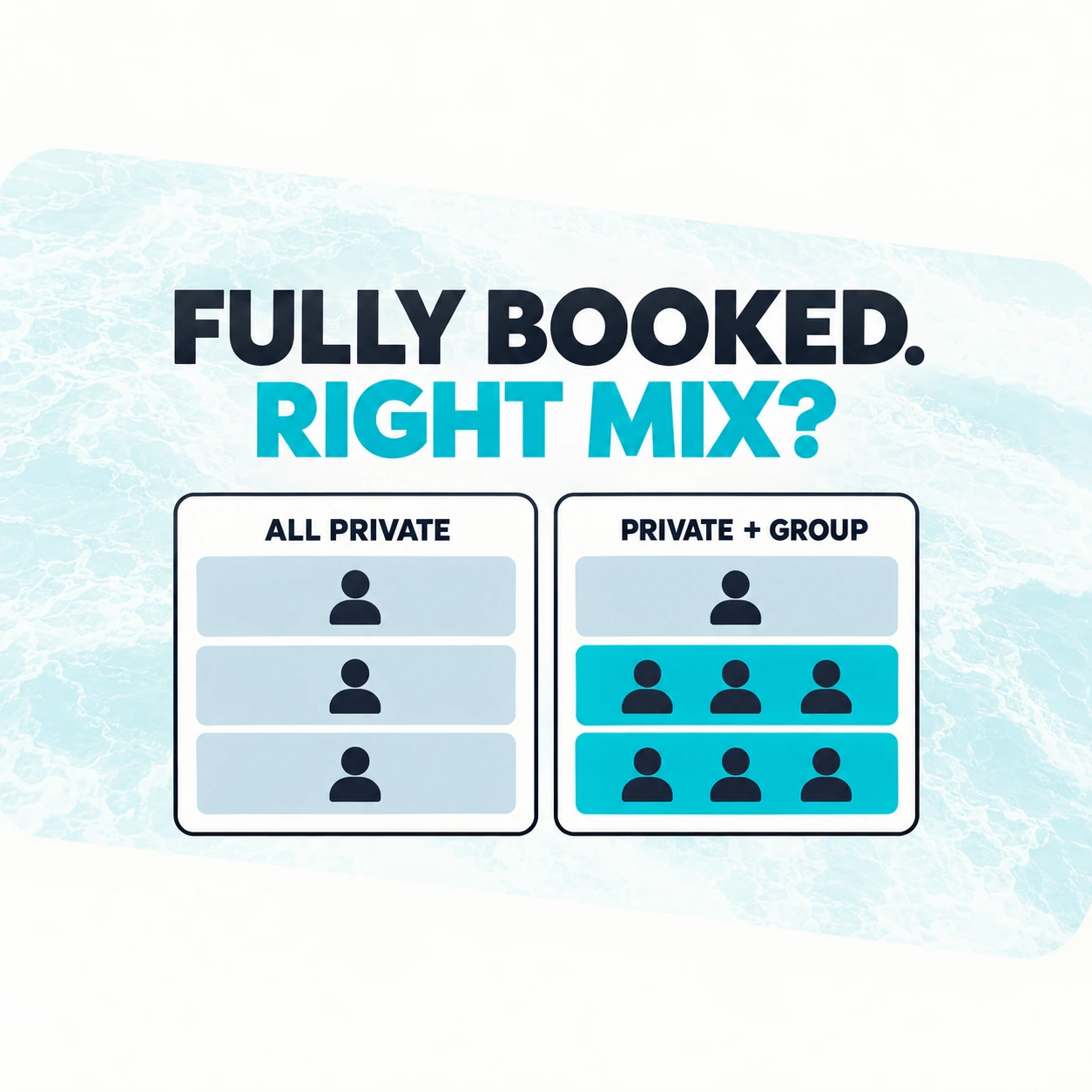
Being fully booked is good. But if limited instructor capacity is used for the wrong product mix, you can still leave revenue on the table. With the right availability rules, you can control what customers can book at peak and off-peak times.
A booking calendar does not need to offer the same product mix all week. Your Saturday afternoon and Tuesday morning have different commercial value, so your availability can reflect that.
Peak weekend slot
Quiet weekday slot
The exact setup will differ per school. The important part is that your booking availability follows your commercial priorities instead of simply opening every product whenever someone could theoretically teach it.
Imagine you run a surf school offering private and group lessons.
On a quiet Tuesday morning, selling several private lessons can make perfect sense. There is capacity available and those customers aren't taking space away from a busy group lesson.
Saturday afternoon is different. Demand is high and instructor capacity is limited. If every instructor can be booked for a private lesson, you may quickly fill your schedule with private customers while losing the opportunity to run more valuable group lessons.
The question isn't only: how many bookings can we take? It is also: which bookings do we want to use our limited capacity for?
This is where product availability becomes a commercial tool rather than just a calendar setting.
Viking allows each product to have its own availability. Products can follow different fixed schedules, instructor availability, overall capacity or other relevant planning rules.
So instead of offering everything whenever there is technically space, you can make availability reflect how you want to run the business.
Product availability determines what you want to sell. Instructor availability helps determine what your team can actually deliver.
Instructors can enter their own availability in Viking. You can also define which sports they can teach, where they can work and their priority in the automated assignment order.
When customers book, Viking can automatically match students to instructors based on their configured locations, sports and availability.
That makes instructor availability more than an internal roster. It becomes part of the availability customers can actually book against.
Without clear rules, the planner has to make more commercial and operational decisions manually.
Should this instructor take another private lesson? Should we keep space for a group? Can another instructor teach this product? Are we already reaching capacity?
With the right product and instructor availability set up, more of those decisions are already reflected in what customers can book.
Viking monitors available slots, instructors and inventory to prevent overbooking, while the planner can still see the daily schedule and make changes when necessary.
The software handles the repeatable rules. Your team keeps control over the exceptions.
Online booking software is often approached as a simple question: When do we have space?
For a watersports school, there is a better question: What do we want customers to be able to book with the capacity we have?
Product availability lets you make that choice deliberately. Instructor availability provides the operational capacity underneath it. Viking brings the two together so customers can book within the rules you have set, while your planner keeps an intuitive overview and can adjust the schedule when reality changes.
Being full is good. Being full with the right product mix can be much more valuable.
Want to see how you could set up availability around your own products, instructors and peak hours? Explore Viking's Advanced Planning or book a demo with us.


