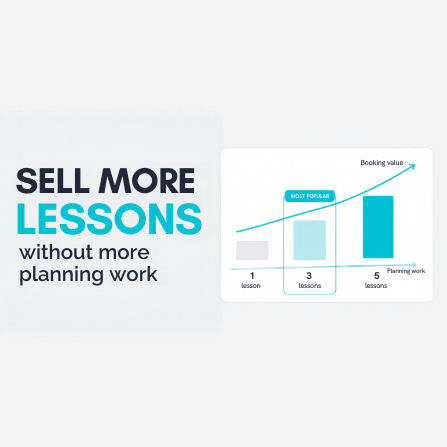
Many watersports schools still sell lessons one at a time. That keeps the first booking small and creates another planning task every time the customer wants to continue.
Viking lets you sell several lessons upfront while customers can schedule and reschedule those lessons themselves afterwards.
A strong lesson-package setup can help you:
The website sells the package. Viking makes it practical to deliver.
If a customer wants to learn to surf, kite or wingfoil, one lesson is rarely the complete journey. Yet many schools still sell exactly that: one lesson.
The customer then has to return for lesson two, three or four, and the school has to sell and arrange every additional lesson again.
With Viking's Booking Engine, customers can buy multiple lessons in one booking. Pricing can also become more attractive when they choose more lessons.
That changes the commercial question from:
How do we get this customer to book again?
to:
How much of their learning journey can we sell in the first booking?
Simply adding a three- or five-lesson option is not enough. Your website still has to convince the customer to choose it.
A simple offer could look like this:
1 lesson
Good for trying the sport.
3 lessons: Recommended
Better price per lesson and enough time to make meaningful progress.
5 lessons: Best value
Lowest price per lesson and a more complete learning programme.
The exact packages will differ per school. The principle is to deliberately highlight the option that works well for both the customer's progression and the business.
Kiteboardschool.nl, for example, presents its two-day beginner course as its best-selling course and gives longer courses clear package pricing and benefits.
The software does not sell the package by itself. Your website creates the preference; Viking handles what happens after the sale.
A customer who buys five lessons does not necessarily have to choose five dates at checkout. They can buy the package, schedule the first lesson and decide on the remaining dates later.
Customers can manage their bookings through their Customer Portal, based on the school's available times.
That gives each side something useful:
Weather makes this especially relevant for watersports.
Without self-service rescheduling, one cancelled lesson can create a chain of WhatsApp messages, emails or calls: find another date, check instructor availability, wait for the customer, then check again if the planning has changed.
With Viking, customers can reschedule through their own account and choose from the availability the school makes available.
Selling more lessons therefore does not have to create the same increase in planning conversations.
If a customer who would normally buy one lesson chooses three or five instead, the value of that first conversion increases immediately.
In our experience with Viking customers, this can be particularly relevant for surf schools. They have traditionally been more accustomed to selling single lessons, while well-positioned packages can encourage customers to commit to several lessons at once.
Selling one lesson at a time is not always what the customer prefers. Sometimes it is simply how the offer has been presented.
Many schools using Viking choose to take full payment for a lesson package upfront. Partial payment is also possible when that better fits the business.
Full payment changes more than the booking size. The customer has committed to a larger part of the learning journey, while the school has received payment for the package rather than only the first lesson.
The right payment structure remains a business decision, but packages give you more options than repeatedly selling and collecting payment for individual lessons.
A lesson package does not need to remain usable forever. In Viking's standard settings, you can set a default expiration period for new bookings, for example six months, one year or two years.
If a specific offer needs different rules, a product variant can override that default expiration. This lets you keep a standard validity period for normal bookings while giving a promotional or special variant its own expiration.
What happens afterwards is up to the school's policy. You might:
That turns the package into a defined commercial product rather than simply a collection of appointments.
See an example of using an expiration override on a promotional variant in Viking.
A strong setup connects four parts.
Position it as recommended, most popular or best value when that accurately reflects your offer.
The customer buys more of their learning journey through the Booking Engine.
Customers can schedule and reschedule lessons from their Customer Portal.
The school decides the package price, payment structure, validity and conditions.
Putting your existing one-lesson-at-a-time process online is useful, but it does not necessarily improve the commercial model.
If the old process is:
sell one lesson, plan one lesson, repeat
and the online process works exactly the same way, you have mainly digitised the old workflow.
A stronger model is:
sell more of the customer's learning journey upfront, then let the customer manage the flexible planning afterwards.
That is the real opportunity behind lesson packages.


