Most rental systems ask customers to decide how long they want to rent before they start. For many watersports rentals, that is a strange question.
You might plan to surf for two hours and come back after 30 minutes because the conditions are terrible. Or the waves are perfect and you stay out for six hours.
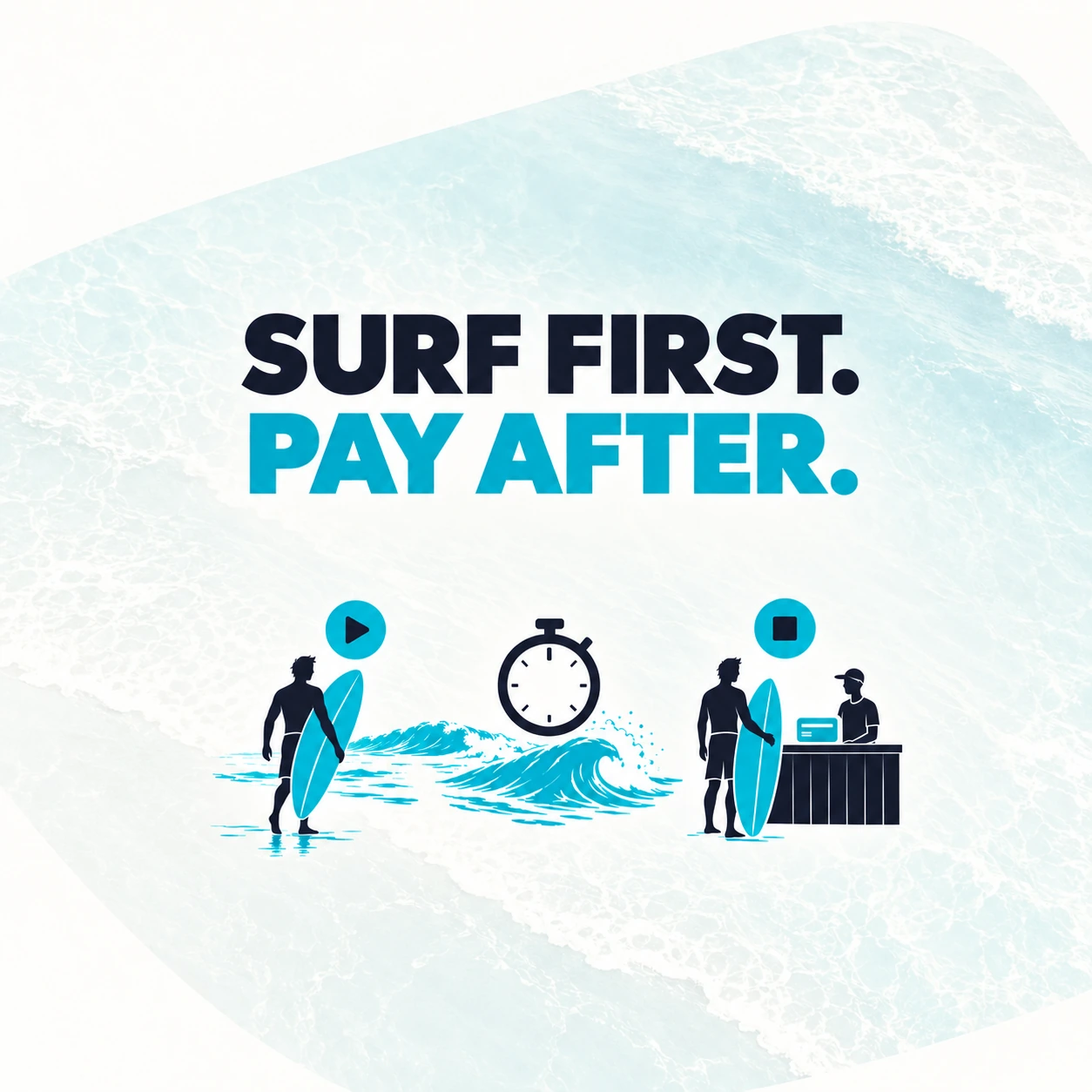
At Hart Beach, the idea is simple: let the customer decide when the session is finished. Viking's time-based rental software was built around that principle. Start the rental when the customer takes the equipment, stop it when they return, and let Viking calculate the actual rental time and price.
A traditional rental normally starts with a duration. The customer books a surfboard for one hour, two hours or perhaps a full day and pays for that period.
That works when the end time matters. But it does not always match how people actually experience watersports.
Conditions change. People get tired. Sometimes a session is disappointing. Sometimes it is so good that the last thing a customer wants to think about is whether their two-hour rental is almost finished.
Time-based rental turns that process around. The customer chooses when to come back, and the rental duration is calculated afterwards.
That gives the customer more freedom without asking the rental staff to keep track of every session manually.
When an existing customer walks into the center, the employee finds the customer in Viking and selects the products they are taking. That could be a surfboard and wetsuit, for example. The employee then clicks Start Rental.
For a new customer, the process starts on an iPad. The customer enters their details, reads the rental terms and signs to accept them. The employee then selects the rental products and starts the rental.
The customer can now go on the water.
When they return, the employee clicks Stop Rental. Viking uses the start and stop time to calculate the rental duration and the amount the customer needs to pay.
Time-based rental software records when a rental starts and stops and calculates the price from the actual rental duration, instead of requiring the complete rental period to be chosen in advance.
Hart Beach in Scheveningen uses this model for its walk-in rentals. Hart Beach tells customers that they can walk in without a reservation and pay afterwards based on the time they actually rent.
The philosophy behind it is customer-first: someone renting a surfboard should not have to predict their session before they have even entered the water. They take the equipment, go surfing and return when they are finished.
This is also why time-based rental is different from simply offering one-hour, two-hour and three-hour rental products online. The end time remains open.
Hart Beach was an important use case behind Viking's Rental on Location functionality. Today, around 20 watersports schools use the module for their walk-in rentals.
There is another advantage for the rental business.
Without a system recording the actual time, rental staff can easily start estimating at the counter.
A customer has been away for one hour and 23 minutes. Instead of working out exactly what is due, someone says: "Just make it an hour."
That may feel insignificant once. Repeated across many rentals, those small differences can become meaningful.
With Viking, the pricing rules determine the amount instead.
A center can set a fixed fee for the initial rental period and then continue charging in smaller time increments. Depending on the product and pricing model, that could mean charging every 5, 15, 30 or 60 minutes after the initial period.
The customer gets the freedom to stay out longer, while the center still charges according to the time actually used.
Time-based rental does not have to start with a payment every time someone walks through the door.
Rental centers can also sell prepaid rental credit.
For example, a customer could pay €100 and receive €150 in rental credit. Another package could offer a larger amount of credit for a larger upfront payment.
These rental credit packages can be made available in the customer's Viking account. A returning customer can buy credit online and use it for future rentals.
For the customer, that can make frequent rental more attractive. For the center, it creates an opportunity to sell future rental before the next session has even happened.
This is especially interesting for schools with local or returning customers who regularly rent equipment but do not necessarily want to buy their own.
Surfboard rental is an obvious use case, but the same rental model can be used much more broadly.
A surf school might rent surfboards, wetsuits, boots or hoods. A SUP center could let walk-in customers take a board without deciding exactly when they will return. A kayak rental business could use the same start-and-stop principle.
For a windsurf center, the rental could be a complete setup or individual equipment. At a kitesurf school, it might be a kite, board, harness or complete kitesurf set.
And for a multi-activity center, different types of rental products can be handled through the same process.
The underlying question is always the same: does the customer really need to choose the end time before the rental starts?
If the answer is no, time-based rental can be a more natural way to sell the rental.
Time-based rental is not automatically the best model for every rental business.
If a specific board needs to be back at 14:00 because another customer has already booked it, a fixed rental period makes sense. The business needs a known return time.
But many watersports centers operate differently. They have enough rental equipment and care more about how many customers are currently using it than exactly which board needs to return at a particular minute.
In that situation, an open return time can give the customer considerably more freedom.
The center can still see its active rentals and how many rental customers are currently out on the water. When someone returns, the actual rental time determines what they pay.
That is a very different model from forcing every walk-in customer into a predefined one-hour or two-hour booking.
What is time-based rental software?
How does walk-in rental software work?
Can rental software automatically calculate the rental price?
Can new rental customers sign terms on location?
What equipment can be used for time-based rental?


