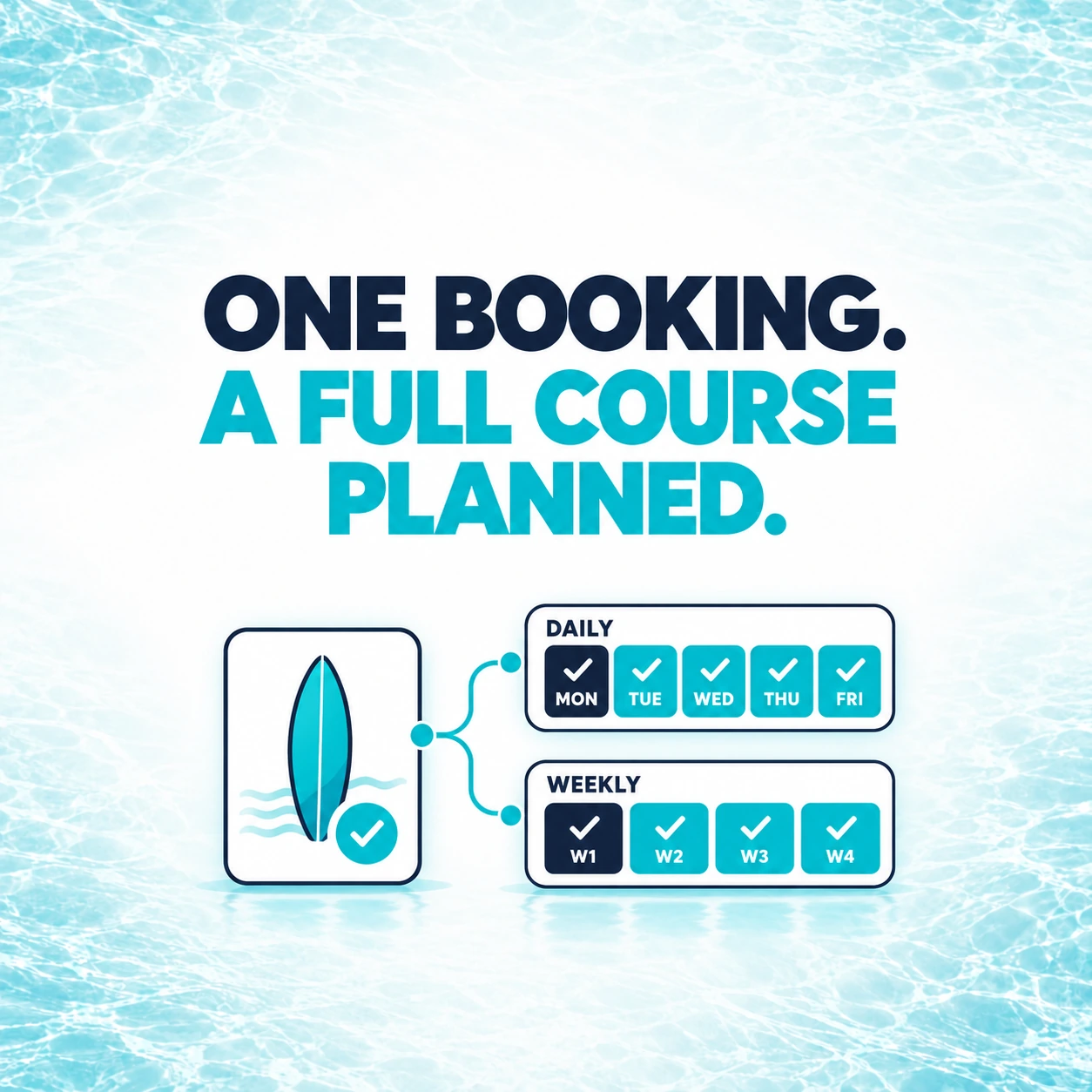
A five-day windsurf course is one product for the customer, but five separate moments in your planning. An eight-week kids course can mean eight Wednesday afternoons that all need to appear in the right place.
That does not mean every lesson has to be planned separately.
With recurring course scheduling, the customer can choose the first lesson and Viking can automatically schedule the remaining lessons daily or weekly. The school gets an overview of the complete course, while the customer can see the individual lessons in their Customer Portal.
Multi-day watersports courses come in different forms. A windsurf school might offer five consecutive days of lessons, while a surf, SUP, kite or wingfoil school might run an eight-week kids course every Wednesday afternoon.
Commercially, these are complete courses. Operationally, however, every day still matters.
Customers need to know when each lesson takes place. The school needs those lessons in its planning. Instructors may need to be scheduled. And communication can be different for Tuesday's lesson than for Wednesday's.
The useful part is keeping the course together without losing control of the individual lesson moments.
For a course that takes place on consecutive days, Viking can use Daily Repetition.
The customer chooses the first date and time. If a five-day windsurf course starts on Monday at 10:00, Viking can schedule the remaining course moments on the following days at the corresponding time.
The customer does not have to book Tuesday, Wednesday, Thursday and Friday separately. The school does not have to create those lesson moments one by one after receiving the booking.
One course booking can create the complete sequence of lesson moments.
This can be useful for intensive surf, windsurf, kitesurf or wingfoil courses where students follow several lessons within a short period.
Not every multi-lesson course takes place on consecutive days.
A common example is a kids course that runs on the same afternoon for several weeks. A watersports school might offer an eight-week windsurf course every Wednesday at 14:00, for example.
With Weekly Repetition, the customer chooses the first lesson and Viking schedules the remaining course moments weekly. The same principle can be used for recurring surf, SUP, kite, wingfoil or other courses.
This is particularly useful when the customer is buying one structured course rather than eight unrelated lessons. The schedule in Viking can reflect that structure from the moment the course is booked.
Automatically creating the schedule is only part of the benefit. A course that lasts several days or weeks also needs to remain understandable for the customer.
The individual lessons appear in the customer's Customer Portal. Instead of remembering that they bought an eight-week course and keeping track of the dates elsewhere, customers can see their scheduled lessons in their own account.
That also gives the school a useful basis for communication around individual course days. Depending on how the school has configured its communication, customers can receive information before a lesson, for example whether tomorrow's session will go ahead or practical instructions about what to bring.
The course is sold as a whole, while each lesson can still be treated as its own operational moment.
A five-day activity does not automatically have to be configured in the same way as every other five-day activity.
The important question is what determines whether another customer can book.
For a Camp, availability does not depend on Instructor Availability. Imagine a kids camp with space for a maximum of 15 participants. If the important constraint is simply whether another place in the camp is available, the capacity can be managed through the product availability rules.
A Course is more appropriate when instructor availability also needs to determine whether the customer can book. Viking can then take both the product setup and the availability of suitable instructors into account.
Camp is useful when capacity is primarily about the product. Course is useful when instructor availability needs to be part of the booking decision.
That distinction matters because the goal is not simply to automate repeated dates. It is to automate them using the availability logic that matches how the school actually operates.
A recurring course and a lesson package can both contain multiple lessons, but they solve different customer journeys.
With a structured five-day or eight-week course, the lesson pattern is part of the product. The customer is buying a course that follows a defined daily or weekly rhythm.
A flexible lesson package works differently. Customers can buy several lessons upfront and plan those lessons according to the possibilities you give them, rather than automatically following one recurring schedule.
If the schedule is part of what you are selling, recurring course scheduling can create that schedule automatically. If flexibility is part of what you are selling, a lesson package can give the customer more freedom to plan the individual lessons.
Read how lesson packages let watersports schools sell more lessons upfront.
A five-day course may contain five lessons. An eight-week kids course may contain eight. For the customer, however, both can still be one clear product they decide to buy.
Viking lets that commercial structure continue into the planning. Daily and weekly repetition can create the individual course moments automatically, customers can see those moments in their Customer Portal and the school can still manage each lesson as part of its daily operation.
One course can create multiple lesson moments without creating multiple manual planning jobs.
Want to see how this could work for your school? Explore Viking's Advanced Planning or request a demo.


