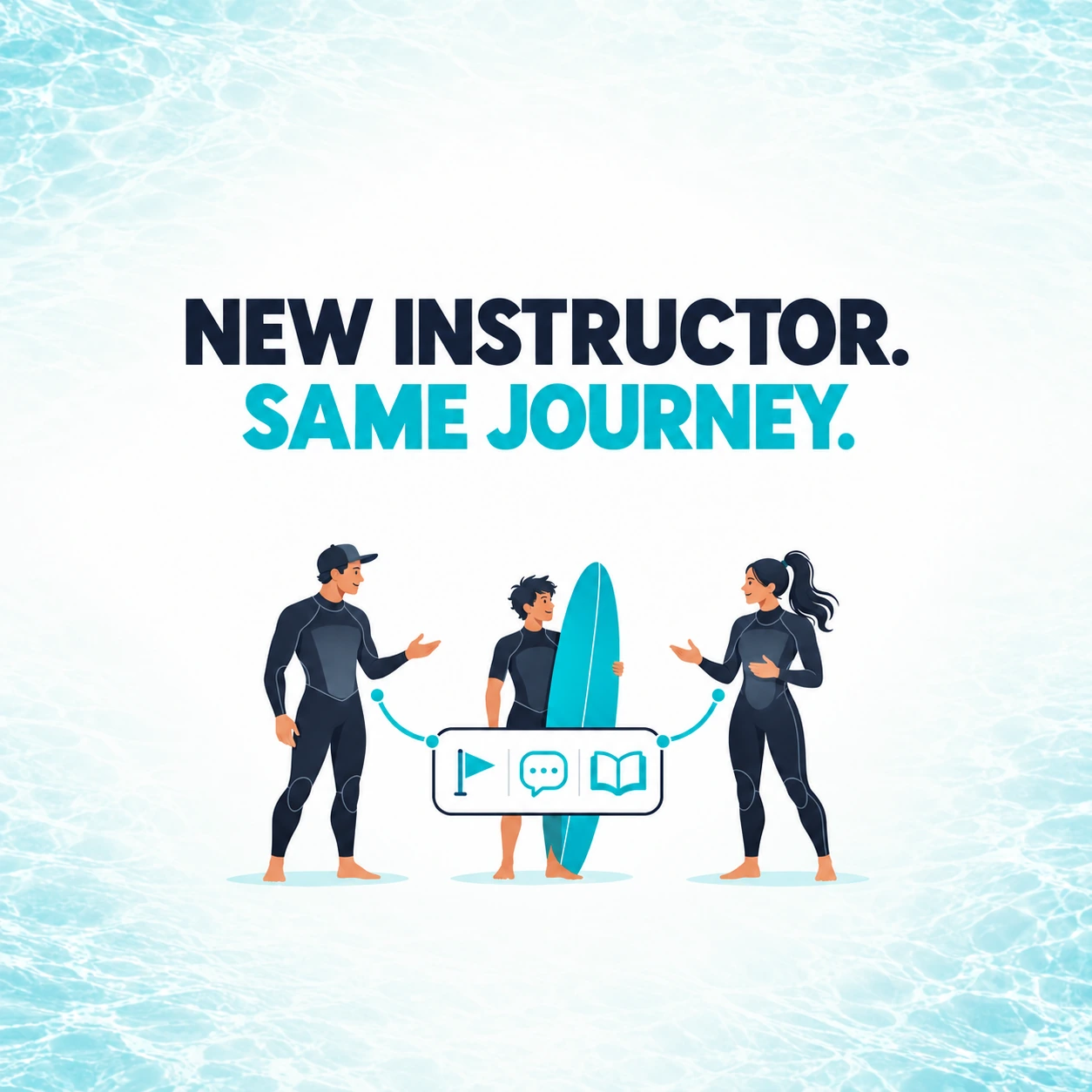
When a student returns for their next lesson, the instructor should not have to start by asking: “What did you do last time?”
That becomes especially important as a watersports school grows. Students may have different instructors across their lessons, groups need to be matched by level and every instructor still needs to know what a student is ready to learn next.
Tracking student progress gives instructors that context before the lesson starts. With Viking, the student's level, previous comments and relevant lesson theory can follow them through their learning journey.
Without shared progress information, knowledge about a student can stay with the instructor who taught them.
When another instructor takes over, they first need to establish what the student has already learned, what went well and what they should work on next. Multiply that by a busy day with several groups and instructors, and valuable context can easily become dependent on conversations between staff.
Viking keeps the student's level available in the planning. Instructors and planners can see where someone is in their learning journey before deciding what should happen next.
The student's progress belongs to the school, not just to the instructor who taught the previous lesson.
Progress tracking is also useful before the lesson begins.
Putting someone taking their first lesson in the same group as someone several lessons further into their course can make teaching harder for the instructor and less useful for both students.
Viking shows student levels in the planning, so planners can use that information when creating groups. Levels can be combined with other information available in the daily planning to decide which students fit together.
Better information about ability makes it easier to put students with a similar learning need together.
In practice, we see Viking schools use this to improve the quality and consistency of their lessons, especially when multiple instructors and groups are running at the same time.
Learning is rarely as simple as completing one lesson and automatically mastering the next skill.
Schools can build their lesson plan around the way they actually teach. A student might move through an early part of the learning journey relatively quickly, while a more advanced stage can require several lessons before the next theory level becomes relevant.
Viking can use that lesson structure to track progress. Instructors and planners can also manually adjust a student's level when their actual ability differs from the expected progression.
The lesson plan provides structure, while the instructor can still use their judgement.
Not every detail needs to become part of a student's level.
Sometimes the next instructor simply needs to know something important about that particular student. For example, a student may be especially nervous and need a little more reassurance during the next lesson.
Instructors can leave comments that become part of the student's course history and are visible to other instructors. This gives the next instructor useful context without requiring staff to document every detail of every lesson.
Levels show where the student is. Comments can explain what the next instructor should know.
Consistency is not only about what instructors know. It also matters what students have been taught.
If every instructor explains the basics differently, students can arrive at later lessons with different theoretical foundations. Viking Milestones lets schools connect lesson theory to different stages of the learning journey and make that material available in the Customer Portal.
Schools can use Viking's pre-built lesson content for sports including kitesurfing, surfing, wingfoiling, windsurfing and SUP, or adapt the content to match their own teaching method.
As students progress, new theory can become available for the next stage.
Students can arrive with the same core theory, even when different instructors teach their lessons.
That gives instructors a clearer starting point and lets practical lesson time focus more on applying what the student is learning on the water.
Progress tracking also changes the experience for the student.
Instead of individual lessons feeling disconnected, students can see their level and access theory that matches where they are in their learning journey. Theory that has not yet been unlocked also makes the next stage visible.
In Viking's experience, that can create curiosity about what comes next and give students another reason to continue their lessons.
This connects naturally with selling lesson packages. The school can sell more of the learning journey upfront, while levels and Milestones help make that journey visible after the booking.
A lesson package gives the customer more lessons. Progress tracking can help those lessons feel like one learning journey.
Read how watersports schools can sell more lessons upfront with lesson packages.
A small school can keep a surprising amount of student information in the heads of its instructors. That becomes harder as the number of students, instructors and groups grows.
Student levels, instructor comments and shared lesson theory give that information a place where the rest of the team can use it. Planners can build better-matched groups, instructors can understand students before a lesson begins and customers can see their own progress.
The goal is not to replace an instructor's judgement. It is to make sure every instructor starts with the information they need to teach the student in front of them.
Want to see how this could work for your school? Explore the Viking Customer Portal or request a demo.


