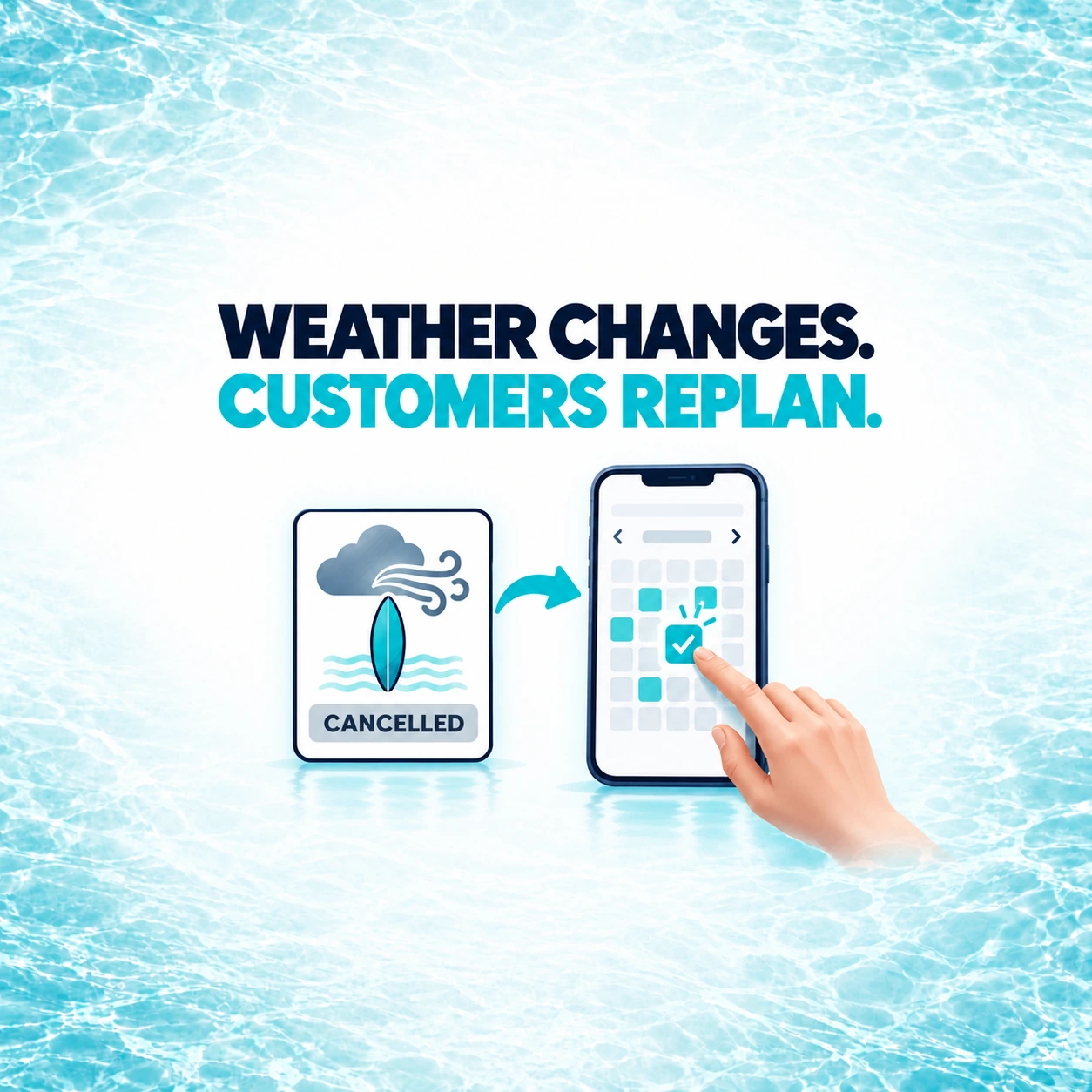
Weather cancellations are part of running a watersports school. A surf school may have to cancel because there are no waves, while a kitesurf or wingfoil school may have to change its plans because there is not enough wind.
Deciding that a lesson cannot go ahead is usually not the difficult part. The work starts when every affected customer needs a new place in the schedule.
Cancelling a lesson doesn’t have to mean replanning every customer yourself. With the right availability in place, customers can choose a new lesson themselves. That saves the school a lot of back-and-forth and gives customers more freedom to find a moment that actually works for them.
Surf, kitesurf and wingfoil schools have always adapted their planning to the conditions. Sometimes an entire day cannot go ahead, but the decision can also be much more specific. A school might cancel only a certain level, one product category or a small number of bookings while everything else continues as planned.
Viking makes it easier to act on that decision. The daily overview gives you the information you need to see what is planned and decide which lessons should be released for rescheduling.
The bigger difference comes afterwards. Without self-service rescheduling, every cancelled lesson can turn into a separate planning conversation with the customer.
When a surf lesson is cancelled because there are no waves, or a kitesurf or wingfoil lesson cannot go ahead because of the wind, the customer still needs another lesson date. Traditionally, that means the school has to contact the customer and start looking for an alternative.
You might suggest a date only to find that the customer cannot make it, while their preferred date falls on a day when you have no suitable availability. Add unanswered phone calls and delayed email replies, and several weather cancellations can quickly create a long chain of individual planning conversations.
The problem is not just informing people that their lesson is cancelled. It is finding a new moment that works for both calendars.
When a lesson is released for rescheduling in Viking, the customer can be informed by email and/or SMS. The lesson returns to their lesson package, so they can use it again rather than losing it.
The customer then opens the Customer Portal and chooses a new available moment themselves. A surf student can find another day with suitable lesson availability, while a kitesurf or wingfoil customer can do the same without the school having to propose dates one by one.
For the school, that means less manual replanning. For the customer, it means being able to choose a new lesson when it suits them.
Letting customers reschedule themselves can sound like giving away control of your planning. It works differently when the availability they can choose from has already been defined by the school.
In Viking, the availability you configure determines what can actually be booked. You can set availability for products and product categories, while course availability can also take into account which instructors can teach a product and when they are available.
That is what makes the process easier to automate. Instead of a planner checking the same conditions every time a cancelled customer needs a new lesson, you define when a lesson can be booked and let customers choose for themselves within those possibilities.
Good availability therefore does more than help fill your original schedule. It also gives you the confidence to hand replanning back to the customer when conditions force lessons to move.
Read how availability rules can shape what customers can book in Viking.
Weather does not always affect every lesson in the same way. A surf school might cancel one level while another can continue. A kitesurf school or wingfoil school can make the same kind of operational decision based on the conditions, products and customers involved.
That decision remains with the school. Viking makes it intuitive to see what is planned and release the affected lessons for rescheduling, whether that concerns individual bookings, a level, a product category or a larger part of the day.
You decide what can still go ahead. Customers only need to replan the lessons that actually need to move.
It is easy to look at self-service purely as a way to save administrative work, but the traditional process is not particularly convenient for customers either. They have to answer calls or emails, compare the school's suggestions with their own calendar and keep trying until both sides find a suitable date.
With self-service rescheduling, customers can open the Customer Portal when it suits them, see the options that are genuinely available and choose one. They get more flexibility without creating less control for the school, because every option still follows the availability you have configured.
Less manual planning for the school can mean more freedom for the customer.
You cannot automate the decision about whether today's waves, wind or other conditions are right for a particular lesson. That remains a decision for the watersports school.
What happens afterwards can be much easier. Release the lessons that cannot go ahead, inform the affected customers and let them choose a new available moment through the Customer Portal. Your availability determines what they can choose, so self-service does not mean losing control of the schedule.
Cancelling a lesson doesn’t have to mean replanning every customer yourself.
Viking Bookings combines availability, planning, customer communication and self-service rescheduling so that weather changes do not automatically create hours of additional planning work.
Want to see how this could work for your school? See how the Viking Customer Portal works or request a demo.


